完KANZEN · Coming soon
2,135 kanji. 2,135 stories to remember them by.
Every JLPT kanji comes with its own memory trick — adopt the community’s, improve them, or write your own. Kanzen brings them back right before you’d forget.
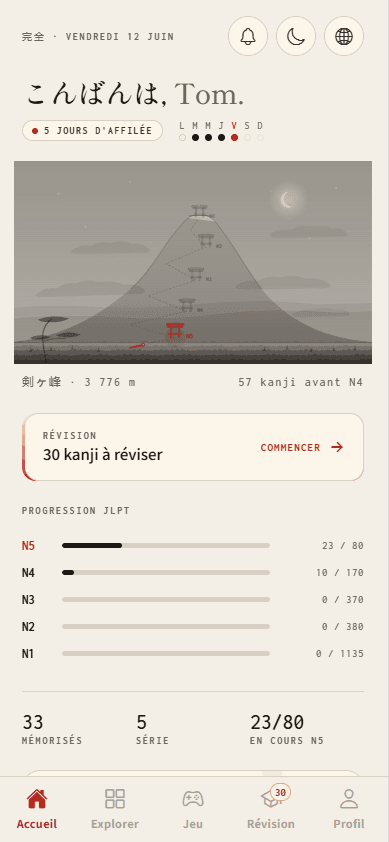
Your progress takes the shape of a climb up Mount Fuji: you always see where you stand and what’s left. Ad-free, on Android (iOS coming soon).
- kanji, N5 to N1
- 2,135
- vocabulary words
- 25,000+
- animated strokes, one by one
- 22,871
- to start, ad-free
- Free
Available on
- Android
- Android tablet
Android 8+ · ~80 MB · iOS coming soon
A look inside
The app, screen by screen.
The real product, not concept art: home, explorer, cards, review, dōjō.
Explorer 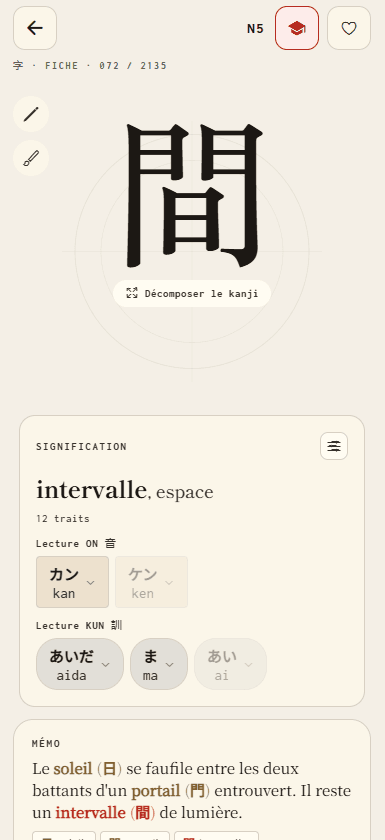
Kanji card 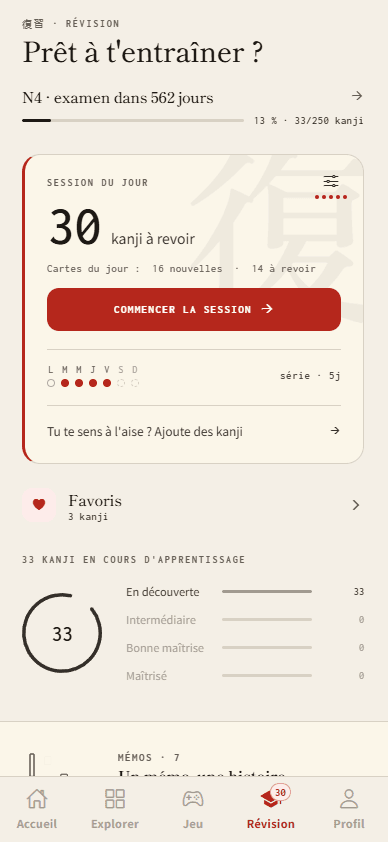
Review 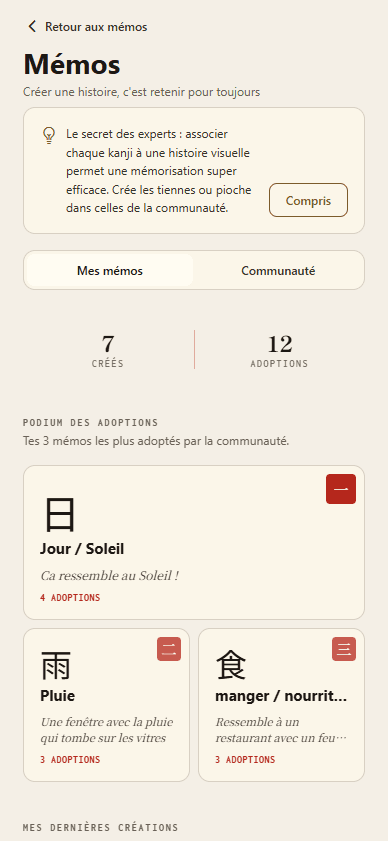
Mnemonics 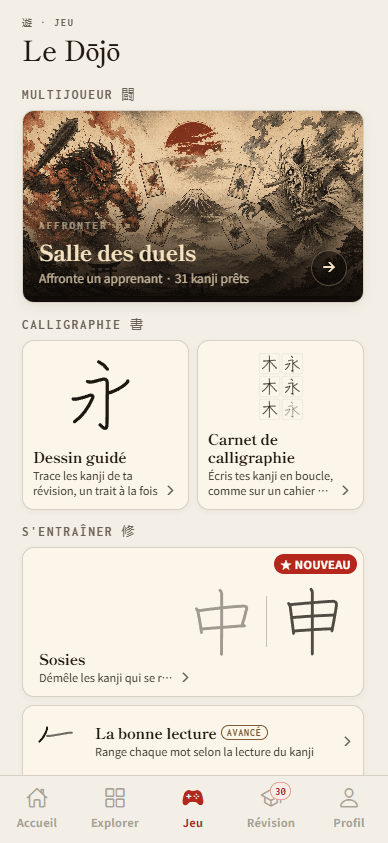
Dōjō
What you can do
Everything you need to learn kanji.
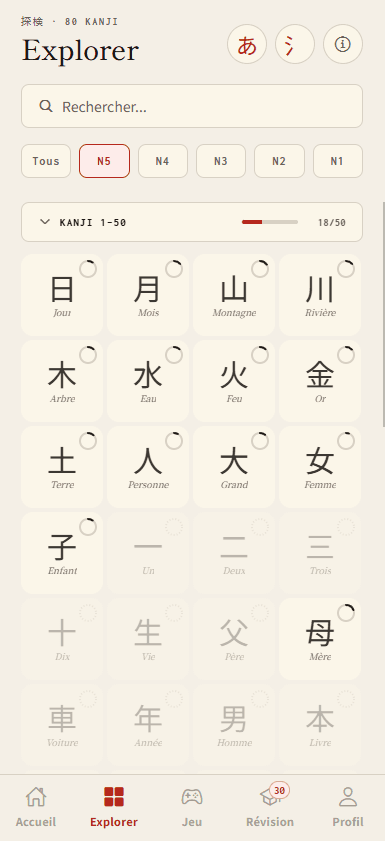
Browse the cards. Open the ones that catch your eye to learn more.
Your progress
See where you stand, at a glance.
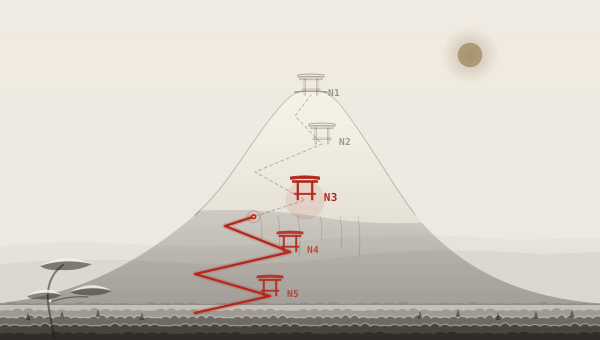
Your progress is a climb up Mount Fuji. Every kanji you learn brings you closer to the summit — you always know what you’ve got and what’s left.
- From beginner to expert
- A map, not a percentage
- Fuji shifts with the hour
Learn more
Instead of a cold progress bar, Kanzen shows you a mountain to climb, with a marker at each level. It’s motivating, and you can actually see how far you’ve come.
A small treat: the Fuji image changes quietly with the time of day. The morning session doesn’t look like the evening one.
Memory
Review at the right time, remember for good.
Every day, Kanzen serves you the kanji to review — right before you’d forget them. It’s the most effective way to remember long term.
- One daily session, tailored to you
- Meaning, reading and vocabulary
- You see what you’ve mastered
Learn more
It’s called spaced repetition: the app works out the best moment to show you each kanji again. The better you know it, the less often it asks. The result: you review less but remember more — and there’s nothing to set up, Kanzen handles it.
For each kanji, it tracks three things separately: its meaning, its pronunciation, and the words it appears in. You start with the meaning; the readings unlock once it’s solid, then the vocabulary — like steps on a staircase. No other app keeps these three memories apart.
Under the hood: FSRS, the most researched memory algorithm around — with nothing to configure, Kanzen handles it all.
Understand
Understand kanji instead of cramming them.
Every kanji is made of small pieces that mean something. Kanzen shows you those pieces: you stop drawing random strokes and start reading a logic.
- Every kanji broken down
- Readings and real examples
- The exact stroke order
Learn more
For example: 明 (“brightness”) combines the sun 日 and the moon 月 — the two brightest things. Once you see these building blocks, you remember far faster, and you can even guess the meaning of kanji you’ve never seen. Each card also gives you the readings, common words, and the official stroke order animated stroke by stroke.
Memory tricks
Tricks that actually work, made by the community.
To remember a kanji, nothing beats a little story. Users create their own, the best ones rise to the top, and you adopt the ones that click for you.
- A trick included for every kanji
- The best ones surfaced
- Create and keep your own
Learn more
A memory trick is just an easy-to-remember image — for example: “日 looks like the Sun.” Some call it a mnemonic, but the idea is simple: tie a kanji to a picture that sticks.
You don’t start from scratch: every one of the 2,135 kanji ships with its own trick, in English and French. And since nobody remembers the same way, Kanzen imposes nothing: pick from the existing ideas, or invent your own. The most useful ones get adopted by other learners — and you can see which ones land.
Practice
Learn by playing, and challenge others.
Mini-games to lock in what you learn, and duels against other learners when you want to test yourself.
- Duels against other players
- Games to stop mixing up look-alikes
- At your own pace, no stress
Learn more
In the Dōjō (the app’s practice space), you can challenge another learner to a duel, or practice solo with small games: telling apart kanji that look alike (like 末 and 未), or sorting words by their pronunciation.
A duel is ten fifteen-second rounds, each player on their own schedule, with 48 hours to finish. Seven yokai leagues — from Tanuki to Kami — rank you by real progress, not by how often you show up.
It’s not just for fun: you remember far better what you’ve handled in a game than what you’ve only re-read.
By hand
Learn to write them, by hand.
Trace each kanji in the right order with your fingertip. The motion helps you remember, and you actually learn to write them.
- Guided tracing, stroke by stroke
- The exact stroke order
- A notebook to practice
Learn more
Kanzen guides you to draw each kanji in the right order, like a handwriting workbook. No grade, no pressure — just the hand learning. It’s also the best way to stop confusing characters that look alike.
Comparison
Kanzen vs WaniKani, Anki and Duolingo: which kanji app?
The honest rundown: what Kanzen does differently from other tools for learning kanji.
Criterion
App language
- Kanzen
- English and French
- WaniKani
- English
- Anki
- Several
- Duolingo
- Follows your phone
Criterion
Number of kanji
- Kanzen
- All 2,135 JLPT kanji (N5 → N1)
- WaniKani
- ~2,000
- Anki
- Depends on the deck
- Duolingo
- Very few
Criterion
Vocabulary
- Kanzen
- 25,000+ words tied to your kanji
- WaniKani
- ~6,000 words
- Anki
- Depends on the deck
- Duolingo
- Limited
Criterion
Devices
- Kanzen
- Android (iOS soon)
- WaniKani
- Website
- Anki
- Desktop + mobile
- Duolingo
- Mobile + web
Criterion
Offline
- Kanzen
- Yes — everything ships in the app
- WaniKani
- Via third-party apps
- Anki
- Yes
- Duolingo
- With subscription
Criterion
How you remember
- Kanzen
- Reviews at the right time (spaced repetition)
- WaniKani
- Its own method
- Anki
- Spaced repetition, manual setup
- Duolingo
- Its own method
Criterion
Memory tracking
- Kanzen
- Meaning, reading and vocabulary tracked separately
- WaniKani
- One grade per kanji
- Anki
- One grade per card
- Duolingo
- No per-kanji tracking
Criterion
Memory tricks
- Kanzen
- Created and adopted by the community
- WaniKani
- Imposed
- Anki
- Write your own
- Duolingo
- None
Criterion
Games and duels
- Kanzen
- Duels and mini-games
- WaniKani
- No
- Anki
- No
- Duolingo
- Yes (solo)
Criterion
Style
- Kanzen
- Clean, Japanese-ink feel
- WaniKani
- Comic, functional
- Anki
- Bare-bones
- Duolingo
- Colorful, busy
Criterion
Ads
- Kanzen
- None
- WaniKani
- None
- Anki
- None
- Duolingo
- Yes (free version)
Criterion
To get started
- Kanzen
- First level free
- WaniKani
- 3 lessons
- Anki
- Free (dated interface)
- Duolingo
- Free with ads
Pricing
Start for free.
The first level is free, with no time limit. Unlock everything else with Kanzen Plus whenever you like.
Free
$0forever
- The whole first level (N5)
- Create & adopt memory tricks
- Core games
- No card needed
Monthly
$5.99/ month
- 7-day free trial
- All 2,135 kanji unlocked
- All games and duels
- Unlimited custom memory tricks
- No commitment
Yearly
$47.99/ year
- 7-day free trial
- About $4 / month — that’s −33%
- Everything in monthly
- One payment a year, no monthly billing
Lifetime
$119one-time payment
- Launch price, will go up
- All updates for life
- You support an independent French studio
Planned launch pricing. No commitment, cancellable anytime from your App Store or Google Play account. The 7-day free trial (monthly and yearly plans) becomes a paid subscription at the end of the period unless cancelled beforehand. Same price on both platforms. Taxes included where applicable. Auto-renewal cancellable whenever you like.
Be there at launch.
Drop your email — we’ll ping you the moment Kanzen ships, and you’ll keep the launch price.
Who it’s for
For beginners, self-learners and JLPT candidates.
You’re studying for the Japanese exam.
Kanzen tracks your progress level by level (the JLPT — the standard Japanese exam — from N5 to N1) and tells you where you really stand.
You gave up on other apps.
Too complicated, too dry, too repetitive? You get the effectiveness back, without the headache.
You’re teaching yourself.
You manage on your own and just needed a tool that tells you what to review today, and honestly measures what you know.
You want to go beyond the basics.
You’ve learned the hiragana and you feel kanji are the real next step. That’s exactly where Kanzen comes in.
FAQ
Frequently asked questions.
Is Kanzen really free?
Do I need to already know Japanese?
What is the “JLPT” and the N5–N1 levels?
What is “spaced repetition”?
How is it better than a regular app?
Is it enough to prepare for the JLPT?
Does it work offline?
Where is my data stored?
Which devices is it available on?
Why no desktop version?
Who’s behind Kanzen?
Be there on day one.
Drop your email: the first level is free at launch, and you keep the launch price.
Android 8+ · ~80 MB · iOS coming soon
Legal documents
Terms of use, data processing, and account deletion procedure for the Kanzen application.